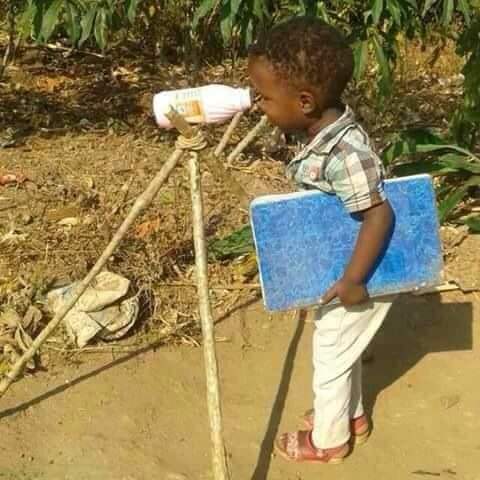
We should not wait until a disease is a ‘number one killer’ to address it aggressively…

Photo by Courtesy of anonymous
 
I’ve been asking myself a lot of questions lately regarding illnesses that do not kill but affect one’s personality’. Do we African’s really know how to detect these diseases early enough? Do all of us know them in the first place? Are the systems to handle them put in place in all our countries? Do we know how to detect, treat, live with or help those affected? I am asking this because the number of mentally ill people roaming the cities without care in Africa is disturbing..
For example, do parents and teachers have the ability to recognize a child with ‘attention disorder’ or who is ‘hyperactive’? ‘Or perhaps such a child ends up being rebuked, mistreated or even get punished everyday? Where is this education available in our countries? Is it in our school curriculum? or in the mainstream media? Where is it provided? Or must each one of us have a teacher-friend, a brother or a relative who knows the condition before we are able to act?

Continue reading

Magonjwa ‘yasiyoua sana’ nayo pia ni magonjwa.. yapewe uzito

Photo by Courtesy of anonymous
 
Nimekuwa nikijiuliza maswali mengi sana. Hivi tunajua vya kutosha jinsi ya kutambua magonjwa yanayobadilisha haiba (personality) na hivyo kutusaidia kujua jinsi ya kuwahudumia /kuishi na walioathirika?
Mfano: je wazazi na walimu wana uwezo wa kumtambua mtoto mwenye ‘attention disorder’ au aliye ‘hyperactive (Mchangamfu kupita kiasi)?’…. au ataishia kutandikwa viboko kila kukicha?.. Elimu hii inapatikana wapi Tanzania? Au ni mpaka ubahatishe kuwa na mwalimu, ndugu au rafiki mwenye ujuzi huo?
Je dalili za magonjwa kama ‘Schizophrenia’ ambapo muhanga huamini vitu vya kufikirika (alinacha)au kusikia sauti kichwani n.k. na pengine kujitokeza katika haiba nyingi mchanganyiko (multiple personalities)- na hivyo wakati mwingine kuonekana kuzubaa, kuwa zuzu au kuwa kama mwenda wazimu zinajulikana?… Magonjwa kama ‘grandiose’ ambapo mgonjwa huwa na ndoto na mipango mikubwa ya kufikirika na pengine kuwa mchangamfu kupita kiasi-je yanajulikana?.. Au wote hawa hudharauliwa na kuitwa ‘VICHAA’? au ‘MVUTA BANGI?’

Continue reading

The Africa we know

Half of Africans are poor and 70% live in rural areas. This makes poverty in Africa largely a rural phenomena. As a matter of fact, a duality exists, where you have an impoverished rural community on one hand, and a richer or better off urban society on the other. Consequently, development in most African countries is inherently urban biased. So we have the developed vs underdeveloped scenario replicated in each African state (Minus the aid industry to help the underdeveloped rural).

Continue reading

The light of African elites should overwhelm darkness

If at all education is light, and if just one bulb lights up a room, then why cant the hundreds of thousands, or millions of educated Africans be enough to enlighten Africa? Is it to do with the intensity of their light, or is it switched off?

I am asking this because every year over 400,000 Africans graduate from universities within Africa alone. If just half of these could engage in efficient economic activities connected with rural villages, poverty would have been reduced by now. But surprisingly, while world poverty has fallen rapidly over the past 40 years (especially in Asia), it has doubled in sub-Saharan Africa (World Bank, 2004). Thus the continent with about 1.111 billion people (2013), has about 48.5% live on $1.25/day; and with about 414 million people (41.4%) live in extreme poverty. This means almost half of the population is actually poor.

Continue reading