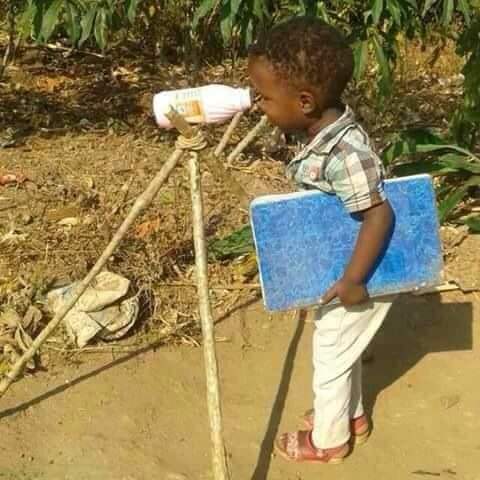
We should not wait until a disease is a ‘number one killer’ to address it aggressively…

Photo by Courtesy of anonymous
 
I’ve been asking myself a lot of questions lately regarding illnesses that do not kill but affect one’s personality’. Do we African’s really know how to detect these diseases early enough? Do all of us know them in the first place? Are the systems to handle them put in place in all our countries? Do we know how to detect, treat, live with or help those affected? I am asking this because the number of mentally ill people roaming the cities without care in Africa is disturbing..
For example, do parents and teachers have the ability to recognize a child with ‘attention disorder’ or who is ‘hyperactive’? ‘Or perhaps such a child ends up being rebuked, mistreated or even get punished everyday? Where is this education available in our countries? Is it in our school curriculum? or in the mainstream media? Where is it provided? Or must each one of us have a teacher-friend, a brother or a relative who knows the condition before we are able to act?

Continue reading

The Africa we know

Half of Africans are poor and 70% live in rural areas. This makes poverty in Africa largely a rural phenomena. As a matter of fact, a duality exists, where you have an impoverished rural community on one hand, and a richer or better off urban society on the other. Consequently, development in most African countries is inherently urban biased. So we have the developed vs underdeveloped scenario replicated in each African state (Minus the aid industry to help the underdeveloped rural).

Continue reading

The light of African elites should overwhelm darkness

If at all education is light, and if just one bulb lights up a room, then why cant the hundreds of thousands, or millions of educated Africans be enough to enlighten Africa? Is it to do with the intensity of their light, or is it switched off?

I am asking this because every year over 400,000 Africans graduate from universities within Africa alone. If just half of these could engage in efficient economic activities connected with rural villages, poverty would have been reduced by now. But surprisingly, while world poverty has fallen rapidly over the past 40 years (especially in Asia), it has doubled in sub-Saharan Africa (World Bank, 2004). Thus the continent with about 1.111 billion people (2013), has about 48.5% live on $1.25/day; and with about 414 million people (41.4%) live in extreme poverty. This means almost half of the population is actually poor.

Continue reading

The impoverished rural Africa is a nakedness for the elite to dress….

Half of Africans are poor and 70% live in rural areas. This makes poverty in Africa largely a rural phenomena. As a matter of fact, a duality exists, where you have an impoverished rural community on one hand, and a richer or better off urban society on the other. Consequently, development in most African countries is inherently urban biased.

Basically, we have the developed vs underdeveloped scenario replicated in each African state (Minus a local aid portfolio to specifically help the underdeveloped rural).

My plea is therefore for the elites to invest in rural areas and close the existing gap. Let them do substantial business with rural people by opening shops, supermarkets, building trade schools /colleges etc., sending good vehicles to do rural transport business, opening entertainment halls, building libraries, pushing the government to electrify all villages, joining forces to have reliable water systems, providing agricultural equipment for hire like tractors, harvesters, millers, etc., establishing real estate business to provide affordable rental houses for teachers, doctors, nurses, etc. so these can feel comfortable to provide services in rural areas,  etc.

Continue reading